|
Many outsiders find it remarkable that there "was" a Mafia in Kansas City. To the uninitiated, KC seems an unlikely setting for a sub-culture commonly associated with larger municipalities and places where palm trees grow. What’s remarkable is how unremarkable the local Mafia is to Kansas Citians. For generations, the local mob was a simple fact of everyday life, something almost as old as the city itself, and something so enmeshed in business and politics that it was taken for granted as an inevitable part of city life. Rare indeed is the senior citizen in Kansas City who doesn’t have some sort of personal, mobster-related anecdote.
The KC family could be described as "typical" in the sense that in Kansas City one finds all the characteristics that have come to represent the American Mafia. It was, however, more openly intertwined with politics than most Mafia families. Its close alliance with the political "Machine" came largely as a result of the close relationship between Johnny Lazia, KC’s Prohibition-era Mafia boss, and Tom Pendergast, the powerful political boss who became the national poster boy for machine politics.
The Pendergast Machine was a combine of Irishmen that dated back to the nineteenth century, when Tom’s older brother Jim was Alderman of the First Ward, which included Little Italy. During Jim Pendergast’s time, KC’s Little Italy was a crowded, mostly Sicilian, extremely insular ghetto where the Black Hand operated with impunity, thanks to the colony’s strict adherence to Omerta. The Kansas City Star found a small crack in the code of silence and first printed the word "Mafia" in an article dated November 24, 1897. In the early 1900’s, a string of unsolved murders motivated the KCPD to assign a special agent named Joseph Raimo to Little Italy. Raimo was on the job only a short time before being shot-gunned to death while walking his beat at Fourth and Holmes. Raimo was replaced with another Italian officer named Louis Olivero. Officer Olivero’s home was bombed and the violence in Little Italy continued, reaching its darkest point in 1919 when a man named Paul Catanzaro murdered a young boy named Frank Carramusa. Carramusa’s father was a fruit peddler who couldn’t put together enough money to pay the Black Hand what they said he owed them. Catanzaro was caught in his murderous act and nearly beaten to death by outraged neighbors. Officer Olivero saved Catanzaro’s life by arriving on scene and arresting him but once again Omerta prevailed and Catanzaro was never convicted. In a cryptic twist of fate, the murdered boy’s brother, Carl Carramusa, would later join the Mafia and become brothers in blood with Paul Catanzaro. Many years later, in the early 1940’s, Carl Carramusa would testify against his fellow mobsters in a case involving an international heroin conspiracy between the KC, St. Louis and Tampa Families. It was a historic case in which Harry Anslinger, the head of the Bureau of Narcotics, first offered hard evidence that a highly organized, national network of crime dominated by Sicilian-Americans, did in fact exist. When Carl Carramusa testified at the trail, Paul Catanzaro, who had murdered Carramusa’s younger brother twenty-five years earlier, sat in courtroom and menaced Carramusa with the evil eye and the devils horn death sign. Several years later, killers tracked Carl Carramusa down in Chicago and blew his head off with a shotgun. Harry Anslinger would cite the Carramusa/Catanzaro affair in his attempts to raise awareness of organized crime. The whole chilling story, from Catanzaro’s murder of young Frank, to brother Carl’s joining the Mafia, to Catanzaro threatening Carl in the courtroom, to Carl’s killing a quarter-century after his brother’s, seemed a perfect illustration of the breadth, scope and treachery of this complicated criminal conspiracy known as the Mafia.
Back when Tom Pendergast took over the First Ward from his brother Jim in 1910, Kansas City was a center for Ragtime music and "saloon politics." Tom cared little for music, but was enamored with saloon politics and the action of making friends, trading favors, and stuffing ballot boxes. From his Democratic club headquarters, Tom Pendergast promoted a wide-open town where every form of vice was well-organized and easily obtained. Big Tom himself was not exactly a barrel of fun. He was an ambitious, intimidating figure who drank little, danced none, went home to his wife and three children early and attended Mass religiously. He did have one, all-consuming vice, which was gambling. When Tom was at the height of his power in the mid 1930’s, he was one of the biggest "whales" in the racing circuit, wagering close to 10 Million a year in today’s dollars.
By the time Prohibition started, Tom had exchanged elected office for behind the scenes political control and a business empire that included a concrete monopoly in the rapidly growing metropolis. His political power grew exponentially in the 1930’s, when he became the most powerful man in Missouri and sent Harry Truman to Washington. He also partnered with Johnny Lazia in a takeover of the police department, staffing it with ex-cons and corrupt officers who protected the rackets and took orders from gangsters. This arrangement led to the Union Station Massacre, a seminal event in the history of American organized crime that changed the nation’s legal landscape and gave birth to the modern form of federal law enforcement that we are familiar with today. The Mafia/Machine combine also made KC the setting for some notoriously corrupt and violent elections.
Johnny Lazia rose to the top by challenging Irish control over politics in Little Italy. In 1928 he launched a successful coup that made him the boss of the North Side Democratic Club. A year later he joined Al Capone, Lucky Luciano, and the other top hoods at the historic Atlantic City Mob Summit. Pulling the strings behind the 30-year-old Lazia was a triumvirate of native Sicilians: Joseph and Peter DiGiovanni, and James Balestrere, Balestrere was a high ranking member of the Unione Siciliano who spelled his last name slightly different from his kin in the Milwaukee Family. These three men were old-world Dons who sequestered themselves inside the Italian community while the American born Lazia became a public figure, a downtown dandy who put his swarthy good looks and stylish clothes on exhibit during his frequent strolls of the city streets. Lazia propelled his trim, welterweight figure with a crisp, confident stride, pausing to give a few coins to a panhandler or engage in an articulate conversation with businessmen and their admiring wives. If Lazia stopped on the sidewalk at the intersection of Twelfth and Baltimore, it meant that he was available without appointment to favor seekers whose numbers swelled as times got worse during the Great Depression. When the crowds got too large or too pushy, Lazia’s bodyguard Charley "The Wop" Carollo would insert his ample body and act as a buffer. As the unofficial but publicly obvious Chief of Police, Lazia turned KC into a safe haven for criminals willing to pay for the privilege. Lazia made friends and drew loyalties from street people who ate in his soup kitchen and high rollers who gambled in his plush casinos. He controlled every racket and amassed a fortune but his empire attracted the envy of two separate crews headed by Joe Lusco and Jimmy "Needles" LaCapra. Both men became prime suspects when Lazia was gunned down on a hot summer night in 1934. Lazia’s funeral likely holds the record as the largest ever in Kansas City. The DiGiovanni/Balestrere triumverate lived on and continued to supervise Family affairs for decades to come. Their inner circle included the aforementioned Paul Catanzaro, the DeLuca and Lascoula brothers, Gaetano Lococo, John Blando, and a name that suggests a link to the Pittsburg Family: John La Rocca
Charley "The Wop" Carollo, took over as front man after Lazia’s demise but ended up snared in a federal probe that sent both him and Tom Pendergast to prison in 1939. Rising to fill Carollo’s shoes was a politically savvy Mafioso named Charlie Binaggio, who successfully merged the Mafia and the Machine and launched a political coup to open the entire state of Missouri to police protected gambling and vice. The prospect of a Missouri-sized Las Vegas was tantalizing to say the least, and Binaggio had little trouble enlisting the help of the national syndicate. In the 1946 election, Binaggio delivered a landslide victory for his pet governor and a slate of other candidates. With a friendly statehouse and Harry Truman in the White House, The KC Family seemed poised to leap ahead of Cleveland to claim the #3 spot behind NY and Chicago. Binaggio came remarkably close to changing Missouri and the Mob forever but came up short. In 1950 he and long-time KC enforcer Charlie Gargotta were murdered in a Democratic Club on Truman Road. The sensational double murder and its political overtones were the catalyst for the historic Kefauver Investigations into Interstate Racketeering and Organized Crime.
Anthony "Fat Tony" Gizzo bossed the family for a brief period in the 1950’s before dying of natural causes and leaving the reigns to his former chauffer, a no-nonsense gangster named Nick Civella. Civella was caught at the Apalachin Confab in 1957 but went on to rule the family until his death in 1983. With his brother and trusted Underboss, Carl "Cork" Civella, at his side, Nick Civella led the family into lucrative ventures in the Teamsters Union and Las Vegas casinos. He also presided over an intra-family war that led to the destruction of an entire city district known as the River Quay. Making up Civella’s inner circle were; brother Cork, nephew "Tony Ripe", gambler Max Jaben, and enforcer Carl "Tuffy" DeLuna. On the fringes was a powerful Capo named William "Willy the Rat" Cammisano, who headed a semi-autonomous crew in the vein of the Riccobene faction in Philly or the Licatas in Cleveland. Nick and Cork and Max Jaben became charter members of the first edition of Nevada’s "Black Book" in 1960.
Nick Civella’s influence with the Teamsters came mainly through Roy Williams, a Kansas City truck driver who would eventually succeed Jimmy Hoffa and Frank Fitzsimmons as top man of the most powerful labor union in the country. Williams and Civella met through Democratic circles in the late 1940’s and became, in Williams own words "very close." Civella used a blend of sincere friendship and sheer terror to keep Williams in his pocket and reap the rewards that came with owning the Teamsters. By the 1970’s, The KC Outfit was skimming a steady stream of cash from several Las Vegas casinos that were purchased with Teamster loans approved by Roy Williams and other mob-friendly trustees. Sharing in the Las Vegas largesse were the families in Chicago, Cleveland, and Milwaukee. It was a sweet deal for the modern mob; a hands-off, mostly non-violent, white-collar conspiracy that delivered cash from the counting rooms by charter jet. It represented the new, relatively clean way of doing things. Unfortunately for Nick Civella, a messy mob war was brewing on the streets of Kansas City. Adding to the pressure was the Kansas City Organized Crime Strike Force, which was patiently bugging businesses and building cases.
The River Quay went from a creaky relic of the 19th Century to a hip and happening center for culture and nightlife when it was redeveloped in the early 1970’s. A mob-connected entrepreneur named Freddie Bonadonna invested heavily in the Quay and became the president of its merchants association. The Quay was rising just as a seedy stretch of 12th Street was being condemned to make way for a hotel project. William Cammisano made a push to relocate go-go dancing and pornography to the River Quay. His efforts were resisted by Freddie Bonadonna, who was loosely aligned with a faction led by the Spero brothers – a trio of tough guys who blamed the Civellas for the murder of their fourth brother; a Teamsters official who turned up in a car trunk in 1972. Tensions between the Civellas and Speros heated up just as Bonadonna’s troubles with Cammisano mounted in a dispute over parking spaces. A lingering distrust between the Civellas and Cammisano’s further complicated the situation. The River Quay became a pressure cooker that exploded in a series of bombings, arson and shootings that left the district looking like a war zone. The River Quay was dead by late 1977, an eerie urban landscape of boarded-up and bombed-out buildings studded with creepy peep shows –a phantasmagoric monument to mob war. Freddie Bonadonna, who lost his father and his business, went into the Witness Protection Program, leaving the Spero brothers to fight the power by themselves.
On May 16, 1978 at approximately 10:00 pm, three masked men stormed into the Virginian Tavern just east of downtown to pull the most aggressive local gangland hit since the Union Station Massacre. The three Spero brothers were in a booth eating a late dinner when the assailants bared down on them with shotguns. For a moment, all was wild chaos punctuated by the deep booms of the shotguns. When it was over, Michael Spero was killed, Carl was paralyzed from the waist down, and Joseph was hit in the arm. Joseph and Carl were both later killed by bombs. After his death, a letter was unsealed in which Joseph blamed the Virginian Tavern hit on Carl DeLuna, Joe Ragusa, and Charles Moretina.
Agents listening in on a meeting between Cork Civella and Carl DeLuna at the Villa Capri Restaurant on June 2, 1978 were hoping to overhear some incriminating conversation regarding the Virginian Tavern hit when they perked up to some talk involving the Teamsters Union, the Chicago Outfit, and someone they called "Genius." The conversation turned the agents on their ears and spun their investigation off in an unexpected and exciting direction. It was the genesis of the famous Strawman case that was popularized by Martin Scorcese’s film adaptation of Nick Pellegi’s book Casino. The Strawman case uncovered the hidden ownership and conspiracy to skim cash from Las Vegas casinos. Two major RICO trials were held in Kansas City and the KC Organized Crime Strike Force made history with convictions of the top men from the four families of Kansas City, Cleveland, Chicago and Milwaukee.
The Strawman case marked the end of the Mob’s sway over life in the Heart of America. When Nick Civella died in 1983, so too did the loyalty and complicity of what was left of the Machine. With the other top guys in prison, there was no one left on the street with the type of chemistry, clout and connections to continue things as they had been before.
But the Mob dies hard, and activity continued. Gangland slayings continued into the mid-1980’s and an FBI affidavit mentions new members being made into the family in 1987. Willy the Rat and Tony Ripe avoided war largely by being in and out of prison at alternating times. The 73 year-old Cammisano was released from an extortion stint resulting from the River Quay just before Tony went away on gambling charges in 1984. Willy’s son William Jr. served as his father’s right hand and involved himself in construction rackets. He went to prison in 1989 just as Tony Civella came out to share power with the elder Cammisano for a few short years before going to prison yet again in 1992 for a conspiracy to divert more than a million dollars worth of pharmaceuticals onto the gray market.
Carl "Cork" Civella and William Cammisano, Sr. died within three months of each other in late 1994 and early 1995. Cork, who was still imprisoned from Strawman, succumbed to complications from pneumonia at the age of 84. Cammisano died from lung cancer at the age of 80.
Willie Cammisano, Jr. was now the highest ranking man on the street but only until Tony Ripe was released the following year. Willie and Tony soon found themselves added to Nevada’s Black Book in the winter of 1997, one hundred years after the word "Mafia" first appeared in the Kansas City Star.
In 1998 Carl DeLuna was paroled after twelve years in federal prison. In Casino the movie, Martin Scorcese portrayed Carl DeLuna as Artie Piscano, a bumbling, doughboy of a wiseguy who never even went to trial because he dropped dead of a heart attack during a raid. In truth, Carl DeLuna is the only one of the defendants depicted in the movie who is still alive today. Fellow old-timer James Duardi, who was a suspect in the Binaggio/Gargotta hit in 1950, also lives on at the age of 87.
After years of emotional turmoil and frustration with the Witness Protection Program, Freddie Bonadonna took his life with his own hand in the spring of 2002.
Violence has continued to plague the Cammisano family into the 21st Century; One of Willy’s nephews was gunned down in his yard in 2001 and another inside his home in 2007. Both crimes remain unsolved.
On February 14, 2006, Anthony "Tony Ripe" Civella died at the age of 75 while on a golfing vacation in Phoenix, AZ. It is tempting to use his passing as a conclusion to the KC story. Then again, a curious mind can’t help but wonder about a teasing remark in Civella’s Star obituary: "Although he only fathered five children, Tony became a beloved father figure to many, many others."
|

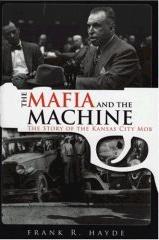 The Mafia and the Machine: